Policy Exception Log Guide
Track policy and control exceptions with approvers, expiry, and compensating controls.
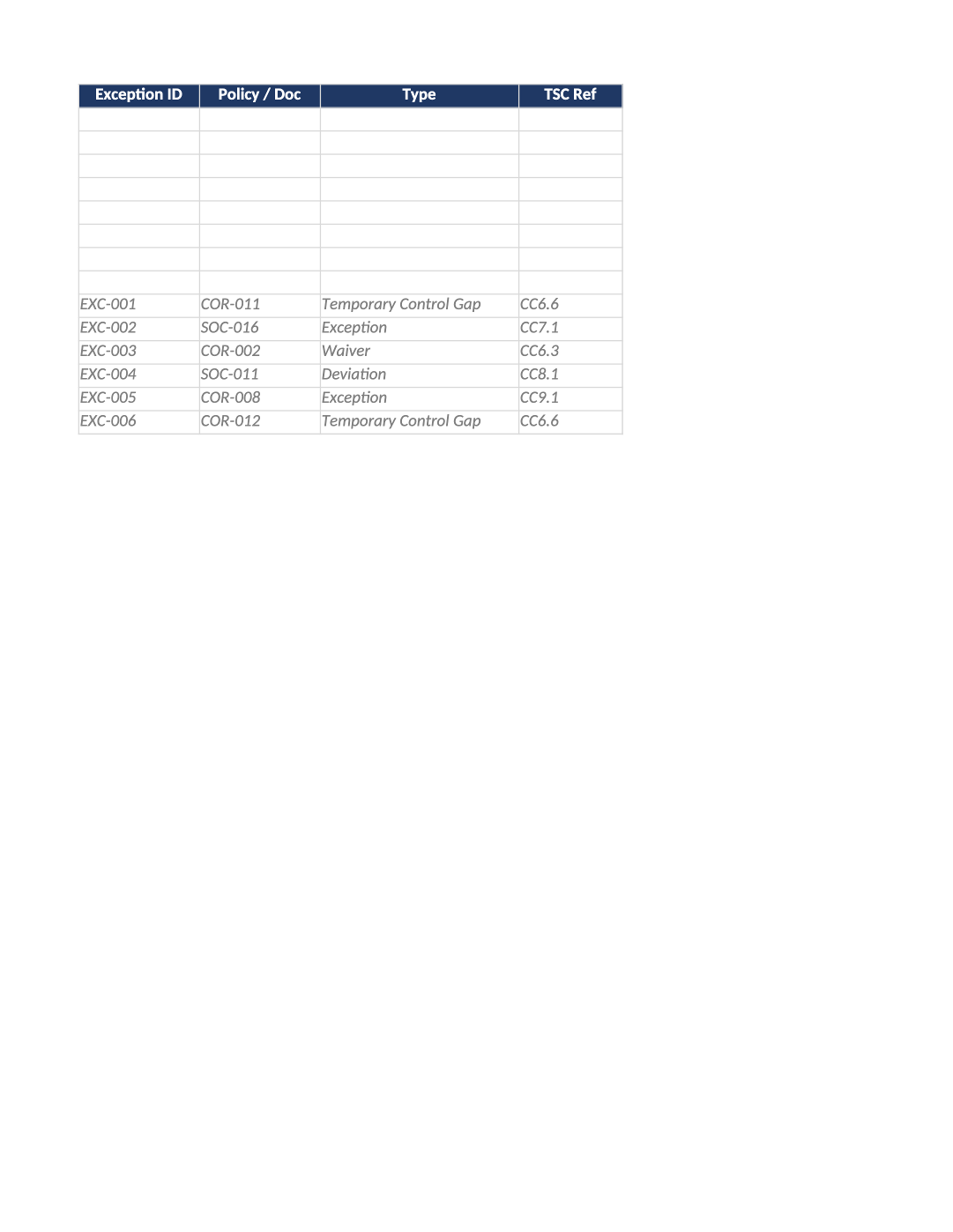
Policy Exception Log
Track policy and control exceptions with approvers, expiry, and compensating controls.
Policy exception log template — Operational log for exceptions — pair with COR-014 risk acceptance forms for material gaps.
Recommended Owner: Security Lead | Approvers per row
What this file is for
Document purpose
Operational log of policy/control exceptions with approval and expiry (CC4.2).
In your program: Material exceptions also need COR-014; link COR-014 Ref column when risk is accepted.
Before you start
Getting Started
- Enable Editing; read the Instructions sheet first for tab order and version metadata.
- Use dropdowns in validated columns; delete gray sample rows before auditor samples.
- Check Dashboard after updates — formulas flag gaps and acceptance rates.
Document tour
Fill out the file section by section
Work through the sections below in order. Each block matches a heading or tab in the downloaded COR-015 file.
- Set workbook owner and audit period on Instructions; review related COR-001 exception process.
- After editing Instructions, search for `[` placeholders and gray sample names — auditors flag incomplete templates.
- Exception ID stable (EXC-###); Policy/Doc = COR or SOC ID being excepted.
- Severity and Status use dropdowns; End Date required for every Open exception.
- COR-014 Ref mandatory when treatment is Accept; Evidence Link = ticket or signed form.
- Review Freq drives steering committee (SOC-017) agenda — monthly for Critical severity.
Exception ID
- Assign stable Exception ID values — never reuse an ID for a different record in the audit period.
- Cross-reference IDs in related toolkit docs (SOC-021, COR-014, HR-001, etc.).
Policy / Doc
- Fill Policy / Doc for every in-scope row on Exception Log — use dropdowns where provided.
- Do not leave cells blank for active records; use N/A with a short reason if truly not applicable.
Type
- Fill Type for every in-scope row on Exception Log — use dropdowns where provided.
- Do not leave cells blank for active records; use N/A with a short reason if truly not applicable.
TSC Ref
- Fill TSC Ref for every in-scope row on Exception Log — use dropdowns where provided.
- Do not leave cells blank for active records; use N/A with a short reason if truly not applicable.
Description
- Fill Description for every in-scope row on Exception Log — use dropdowns where provided.
- Do not leave cells blank for active records; use N/A with a short reason if truly not applicable.
Severity
- Use dropdown values for Severity — align definitions with COR-003, COR-008, or COR-009.
- Inconsistent scoring between this file and meeting minutes (SOC-017/SOC-019) triggers auditor questions.
Requestor
- Fill Requestor for every in-scope row on Exception Log — use dropdowns where provided.
- Do not leave cells blank for active records; use N/A with a short reason if truly not applicable.
Approver
- Name a person (not a team inbox) in Approver — auditors interview control owners.
- Must match COR-005 org chart or SOC-024 control owner assignments where applicable.
Start Date
- Use consistent Start Date format (YYYY-MM-DD) aligned with HRIS, IdP, or LMS exports.
- Dates must match supporting evidence — auditors compare log timestamps to HR records.
End Date
- Use consistent End Date format (YYYY-MM-DD) aligned with HRIS, IdP, or LMS exports.
- Dates must match supporting evidence — auditors compare log timestamps to HR records.
Status
- Select Status from the dropdown — free text breaks Dashboard formulas and heatmaps.
- Update through the lifecycle (Not Started → In Progress → Complete/Closed) before sign-off.
Review Freq
- Use consistent Review Freq format (YYYY-MM-DD) aligned with HRIS, IdP, or LMS exports.
- Dates must match supporting evidence — auditors compare log timestamps to HR records.
COR-014 Ref
- Fill COR-014 Ref for every in-scope row on Exception Log — use dropdowns where provided.
- Do not leave cells blank for active records; use N/A with a short reason if truly not applicable.
Evidence Link
- Fill Evidence Link with a URL, ticket, or export path auditors can open — not a local-only path.
- Re-verify links before fieldwork; broken evidence links are a common audit finding.
Quality check
Before You Finalize
- No Open rows past End Date without renewal row.
- Dashboard shows zero Missing COR-014 Ref for Accepted-risk exceptions.
Evidence
Where to Store It
- Store the completed file in your compliance evidence folder (signed PDF for policies).
- Register the document in COR-013 with version, owner, and next review date.
- Link the file from your evidence index or SOC-005 project plan when you use Phase 3 trackers.