How to Use the Privacy Incident Assessment Worksheet
Policy Overview & Usage Guide for GDPR Article 33/34 and privacy incident response.
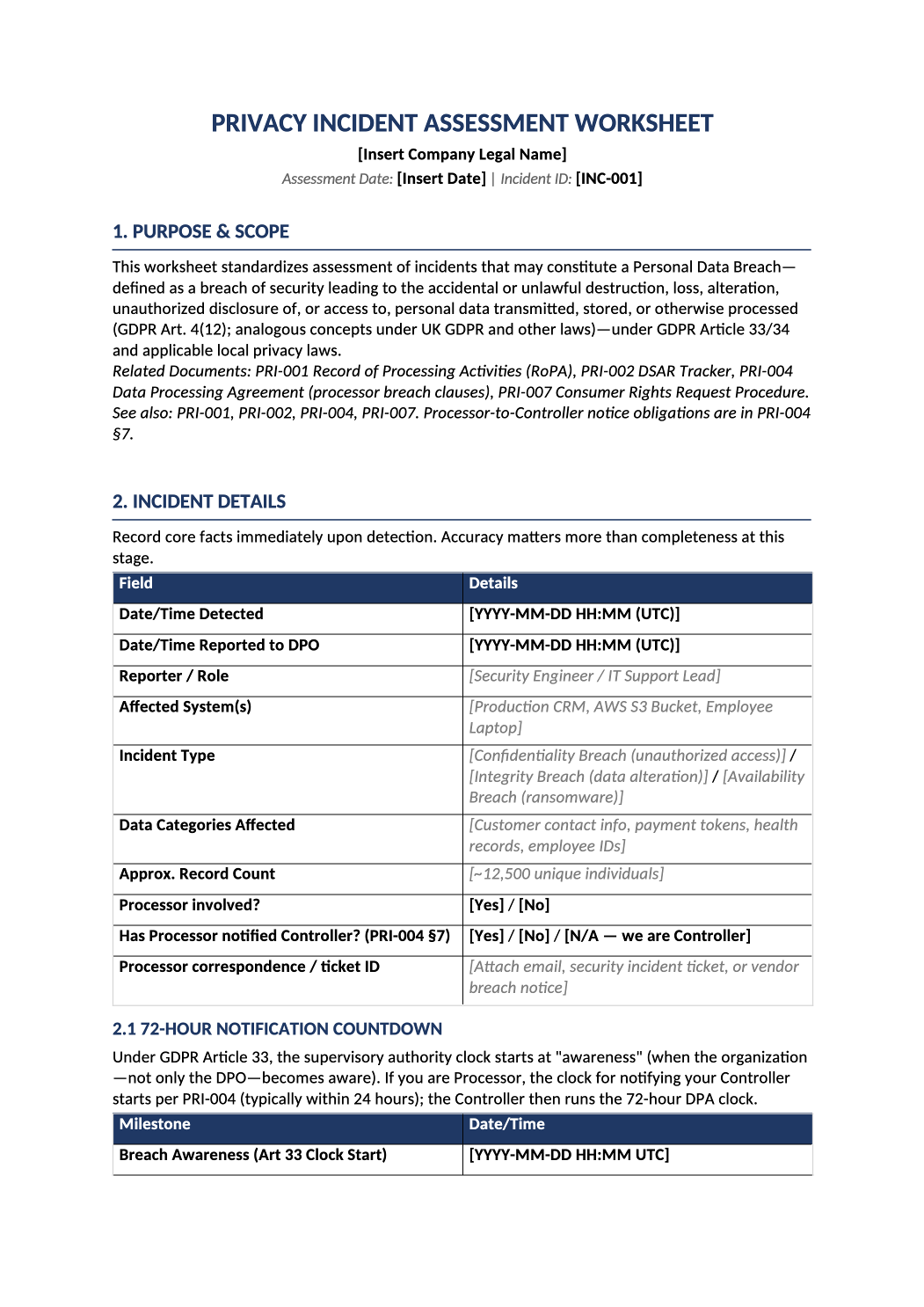
Standardize breach assessment & notification in one document.
This worksheet standardizes the assessment of personal data breaches under GDPR Article 33/34 and applicable privacy laws. It determines regulatory notification requirements, tracks containment actions, and provides audit-ready documentation for incident response.
This worksheet standardizes the assessment of personal data breaches under GDPR Article 33/34 and applicable privacy laws. It determines regulatory notification requirements, tracks containment actions, and provides audit-ready documentation for incident response.
Recommended Owner: Data Protection Officer (DPO), Incident Commander, or Privacy Counsel | Approval Required: Executive Leadership (CEO/CTO) + Legal/Compliance Sign-Off
Section 1
Getting Started
- Understand the Brackets: [Bold Black Brackets] = Mandatory fields/decision points you must complete during the incident. [Italic Gray Brackets] = Examples/guidance showing the expected level of detail. Replace with your actual incident data or delete if not applicable.
- Time-Sensitive Use: This is a live incident response tool. Fill it out in real-time as facts emerge. Accuracy and timeliness matter more than initial completeness.
- Cross-Reference: Aligns with PRI-002 (Incident/DSAR Log), PRI-004 (DPA), and your internal Incident Response Playbook.
Replace all bracketed content during the active response phase. Do not leave placeholder text in archived incident records.
Section 2
Key Things to Decide
Before or during the assessment, clarify these operational points:
-
When did awareness occur? The 72-hour GDPR clock starts when any employee becomes aware, not when the DPO is notified.
-
What is our legal role? Are we Controller, Processor, or Joint Controller? This dictates notification duties, timelines, and third-party coordination.
-
What data & jurisdictions are impacted? Cross-border triggers (EU, UK, US states, APAC) change regulatory obligations and parallel notification paths.
-
Are safeguards intact? Was data encrypted? Were keys compromised? This directly determines whether you can exempt subject notifications under GDPR Art 34.
Section 3
How to Fill Out the Tables
Every section includes [italic gray sample text] to guide you. Here’s how to apply it:
- 1Section 2: Incident Details & 72-Hour Countdown
Purpose: Locks in the factual baseline and starts the regulatory clock.
Action: Record detection time, awareness time, and calculate the strict 72-hour DPA deadline. Use the countdown table to track compliance even if forensic details are pending. - 2Section 2.2: Incident Classification Matrix
Purpose: Categorizes the breach dimension (Confidentiality, Integrity, Availability).
Action: Check all applicable dimensions using the Yes / No brackets. Multi-dimension breaches typically trigger higher risk scoring. - 3Section 3: Risk Assessment & Quantitative Scoring
Purpose: Moves from subjective judgment to defensible risk calculation.
Action: Evaluate qualitative risk factors, then use the 1–5 scoring table to calculate a weighted risk score. Thresholds: Low (≤8), Medium (9–15), High (≥16). Document your evidence in the Assessment column. - 4Section 4: Notification Determination & Cross-Border Impact
Purpose: Maps regulatory obligations based on risk score and geography.
Action: Decide DPA vs. subject notification requirements. Map affected jurisdictions, determine One-Stop-Shop applicability, and check US state AG/credit monitoring triggers. - 5Section 4.2–4.5: Role, Safeguards, Law Enforcement & State Laws
Purpose: Documents legal position, technical exemptions, and parallel reporting paths.
Action: Fill your organization role, verify encryption/key status with Engineering, log LE engagement if applicable, and complete the US state breach checklist. - 6Section 5: Containment, Escalation & Communications
Purpose: Tracks execution, evidence, and stakeholder alignment.
Action: Log containment actions, executive/board/insurer notifications, and DPA/subject communications. Always record the evidence location (portal receipt ID, email thread, ticket link). - 7Section 6: Post-Incident Review & Final Determination
Purpose: Closes the loop and captures lessons learned.
Action: Complete within 30 days. Document root cause, control gaps, and remediation steps. Assign final severity (SEV-1/2/3) and check the Final Determination box to officially classify the incident.
Section 4
Before You Finalize
- Did you replace all [Bold Brackets] with actual incident details, timestamps, and decisions?
- Did you update/remove [Italic Gray Examples] to reflect the actual incident scope and safeguards?
- Is the 72-hour clock accurately calculated from the initial awareness timestamp?
- Has encryption/key compromise status been verified directly with Engineering?
- Are all jurisdictional obligations (EU/UK/US/APAC) mapped and assigned to the correct teams?
- Have executive, board, and insurer notifications been logged with evidence links?
- Has Legal Counsel reviewed the notification determinations and exemption rationales?
Section 5
Where to Store & Execute It
-
Secure Storage Store the completed worksheet in your restricted Incident Response or Compliance repository (e.g., SharePoint, GRC platform).
-
Audit Evidence When regulators or auditors request breach documentation, provide this signed worksheet alongside PRI-002 logs, DPA submission receipts, and forensic reports.
-
Training & Drills Use this template for tabletop exercises. Pre-fill mock scenarios to test your team’s speed, accuracy, and cross-functional coordination.
-
Review Cadence Update the document continuously during active incidents. Close, sign, and archive within 30 days of remediation completion.
Pro Tips
Best Practices for Incident Response
- Start the Clock Immediately: The 72-hour timer begins at first awareness. Log it in Section 2.1 even if full forensic details aren’t known yet.
- Document “Why Not” for Exemptions: If you skip notifying data subjects because data was encrypted, explicitly document the encryption method and confirm keys weren’t compromised.
- Track Evidence Rigorously: Auditors focus on proof of delivery, not just intent. Log file paths, portal receipt IDs, or email timestamps for every notification.
- Keep Severity Consistent: Align the SEV-1/2/3 classification with your existing SIEM/IR program thresholds to avoid conflicting internal reports.
FAQ
Frequently Asked Questions
Notify the relevant DPA immediately and document the reason for the delay. Regulators typically accept delayed notifications if they are accompanied by a credible explanation of why the delay was unavoidable and evidence of rapid internal escalation once the breach was confirmed.
No. Under GDPR Article 34, you can exempt subject notifications if you can demonstrate that the data was encrypted or otherwise unintelligible, and that encryption keys were not compromised. Document this technical verification thoroughly.
If you operate across multiple EU/EEA countries, you generally report only to your lead supervisory authority (where your main establishment is located). That authority coordinates with other concerned authorities, simplifying cross-border reporting.