Risk Management Policy
Document how your company identifies, assesses, and handles risks. Show auditors you have a process for spotting and fixing issues.
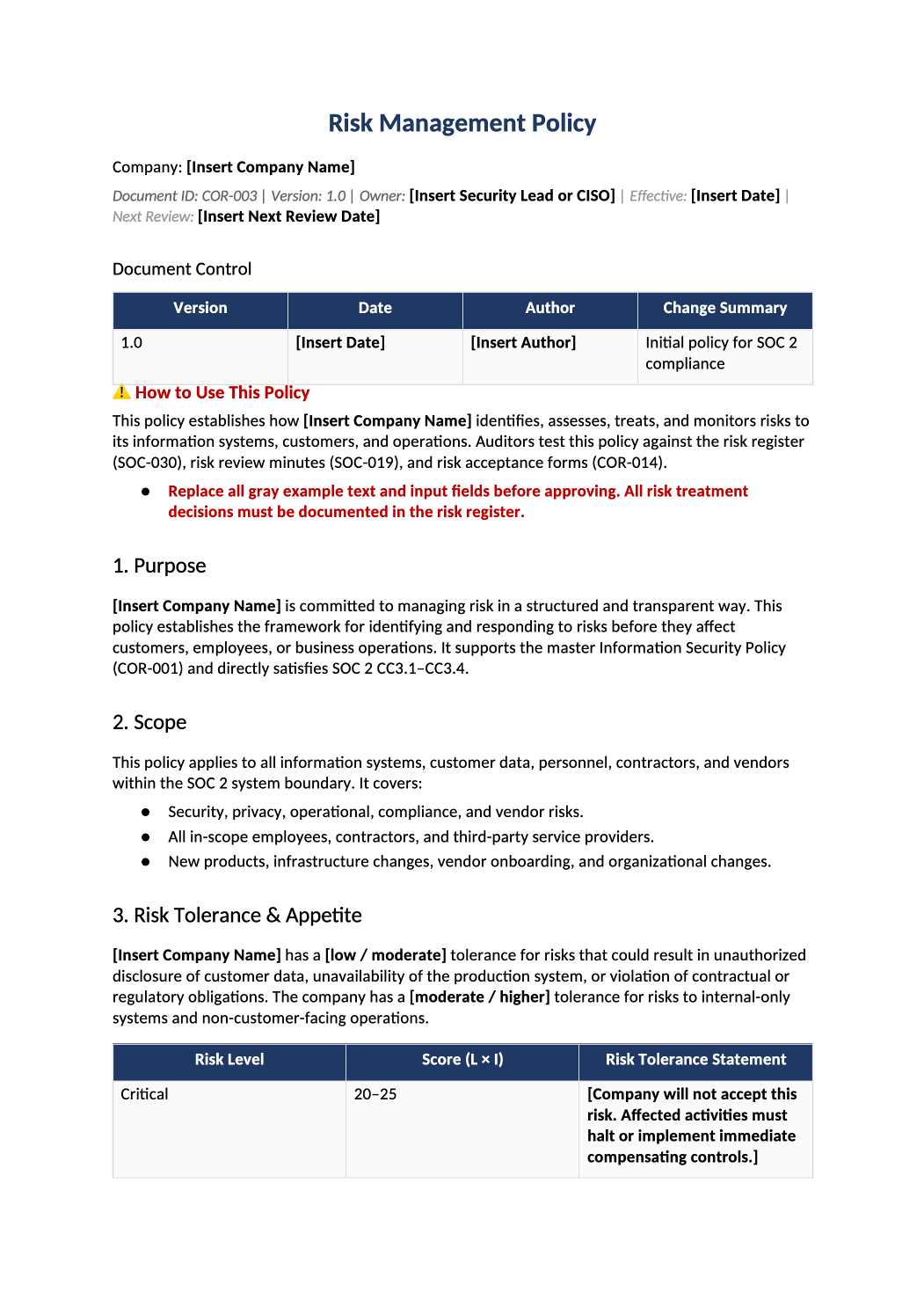
Identify and manage security risks systematically.
Risk assessment methodology, scoring model, review cadence, and SOC 2 mapping — all in one auditor-ready policy template.
Download Risk Management Policy (.docx)Risk management policy template — This template helps you document how your company identifies and handles risks. Auditors want to see that you think about potential problems (like data breaches or vendor failures) and have a plan for them.
Recommended Owner: Security Lead (also referred to as Risk Manager) | Approval Required: Executive Leadership (CEO/CTO)
Section 1
Getting Started
- Enable Editing: Click “Enable Editing” in Word.
- Fill in the Blanks: Replace all [Bold Brackets] with your details.
- Understand the Goal: This isn’t about predicting the future. It’s about showing you have a process for spotting and fixing issues.
Section 2
Key Things to Decide
-
How do we score risk? Section 4 uses a simple “Likelihood × Impact” model. You can keep this standard model or adjust it if you have a different preference.
-
Who decides what’s acceptable? Usually, the CEO or CTO decides if a risk is “okay” to accept. Make sure Section 7.5 (Risk Acceptance Authority) names who can accept risk in your company.
-
How often do we check? Most companies review their risks quarterly or annually. Pick a cadence that works for your team.
Document tour
Section-by-section walkthrough
Open the downloaded COR-003 file in Microsoft Word. Use the headings below as your checklist — complete each section before the final approval block.
- Replace [Insert Company Name] and confirm the objectives match what you actually commit to in SOC 2 and customer contracts.
- Delete gray example bullets if they do not apply to your stage (e.g., GDPR if you have no EU data).
- List every workforce type (employees, contractors) and every system class in scope (prod, corporate IT, SaaS admin consoles).
- Align wording with SOC-004 System Description and SOC-002 scoping answers.
- Define what risk levels leadership will accept vs. what requires mitigation — keep it one page.
- Adjust the likelihood × impact matrix to match your SOC-030 risk register if you use one.
- Delete categories that never apply; add domain-specific risks (AI, payments) if relevant.
- Fill the roles table with real names or titles — match COR-005 Organizational Chart if you use it.
- If one person wears multiple hats, document that explicitly; auditors expect named accountability.
- Work through subsections 7.1–7.5 in order: identify, fraud, treat, change triggers, acceptance authority.
7.1 Identification
- Describe how risks are identified (incidents, audits, architecture reviews) and who facilitates.
7.2 Fraud Risk Assessment (CC3.3)
- Document anti-fraud controls for billing and payments even if lightweight — CC3.3 is often tested.
7.3 Risk Treatment
- Explain mitigate / accept / transfer / avoid and who approves each path.
7.4 Significant Change Triggers (CC3.4)
- List triggers for re-assessment (new product, major vendor, breach) — align with change management.
7.5 Risk Acceptance Authority
- Name the executive who can accept residual risk in writing — not every engineer.
- Point to SOC-030 or your live register; this section describes how the register is maintained.
- Set annual policy review and how long risk assessment records are kept.
10. Vendor Risk Management
- Replace all [bracketed placeholders] and gray examples with specifics about your environment.
- Remove subsections or rows that are not applicable rather than leaving generic sample text.
- Document how exceptions are requested, approved, and time-boxed — use COR-015 exception log if applicable.
12. SOC 2 Criteria Mapping
- Leave mapping tables as-is unless your scope excludes criteria; they help auditors navigate the policy.
Section 4
Before You Finalize
- Did you replace all [Bold Brackets]?
- Does the “Risk Owner” role match your org chart?
- Is the review frequency (e.g., Annual) realistic for your team?
- Did you get the CEO to sign it?
Section 5
Where to Store It
- Save the signed PDF in your compliance folder.
- Keep a copy of your Risk Register (the spreadsheet where you list actual risks) nearby, as auditors will ask for it next.
Pro Tips
Pro Tips for Success
- Start Simple: You don’t need a complex mathematical model for risk. A simple 1–5 scale for Likelihood and Impact is perfect for most startups.
- It’s a Living Document: Your risks will change as you grow. That’s why the “Review Cadence” section is important.
- Don’t Hide Risks: It’s okay to have “High” risks. Auditors just want to see that you know about them and are working on them.
FAQ
Frequently Asked Questions
Yes. This policy explains the rules for managing risk. The Risk Register is the list of actual risks you’ve found. We provide a template for that in Phase 2.
Typically the CTO, Security Lead, and maybe the CEO. Keep it small and focused.
Think about what could go wrong. What if AWS goes down? What if a developer leaves? What if a vendor gets hacked? Write those down in your register.