SOC 2 Readiness Guide
A free, auditor-aligned template to scope your audit, assign owners, and prepare evidence.
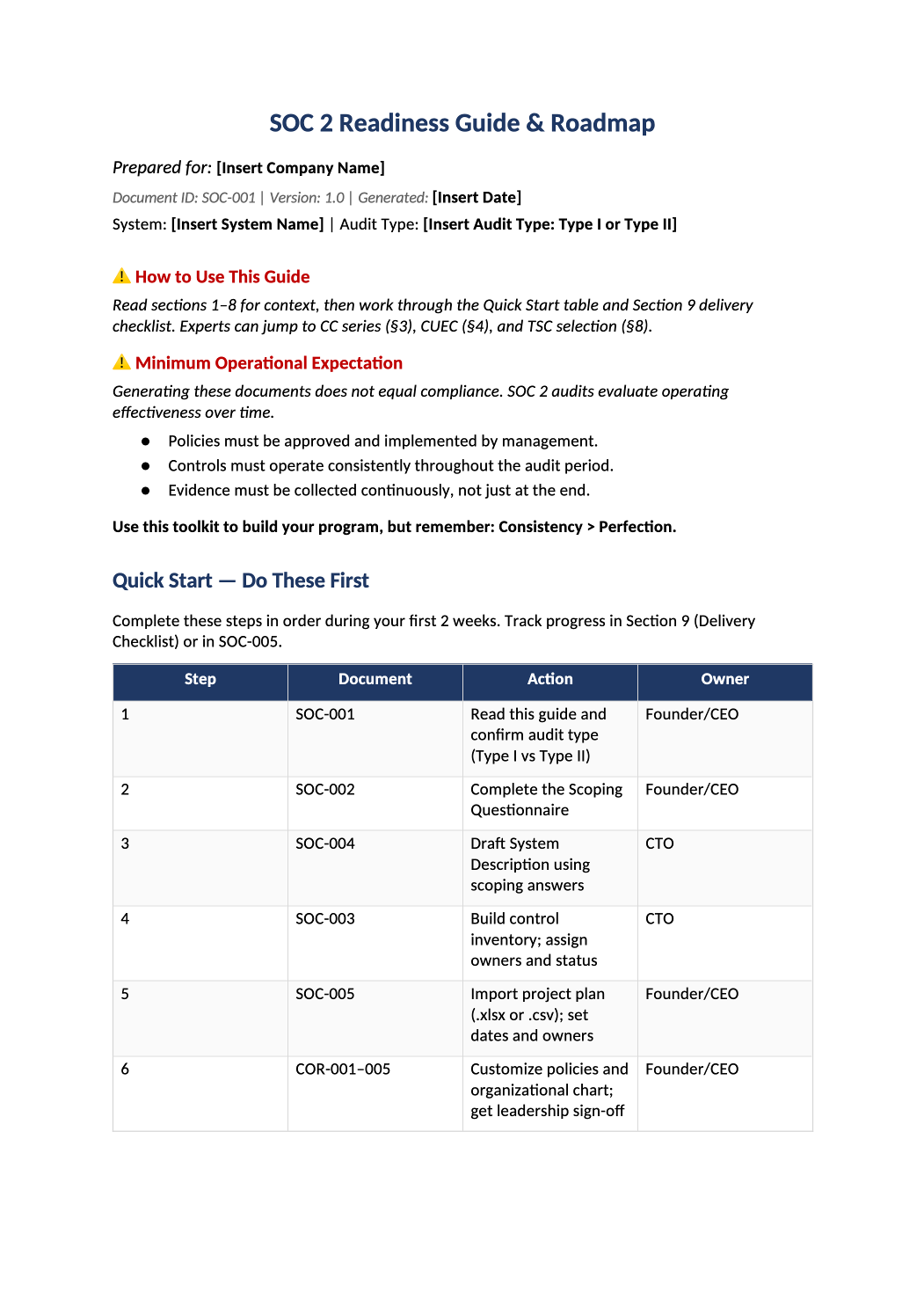
Everything you need to start, in one document.
Scoping prompts, ownership tables, and evidence examples — preloaded so you don’t start from a blank page.
Download SOC 2 Readiness GuideThis guide is designed to help your organization prepare for a SOC 2 readiness assessment and organize the foundational information required for a future SOC 2 audit. Follow the instructions below when completing this document and the supporting templates included in the toolkit.
Step 1
Replace All Placeholder Fields
Throughout this guide, you will see placeholder fields marked in bold brackets, such as:
- [Insert Company Name]
- [Insert System Name]
- [Insert Audit Type]
- [Insert Hosting Model]
Action: Delete the bracketed text and replace it with information specific to your organization.
Pro Tip: In Microsoft Word, press Ctrl+F (or Cmd+F) and search for [ to jump instantly to every field.
Before sharing documents externally or with an auditor, make sure all placeholders and instructional text have been removed or finalized.
Step 2
Define Your Audit Scope
Your SOC 2 scope determines which systems, processes, employees, vendors, and environments are included in the audit. When completing this guide:
- 1Clearly identify the product or service being audited.
- 2Define production systems and supporting infrastructure.
- 3Identify cloud providers, vendors, and third-party services.
- 4Determine whether you are pursuing a Type I or Type II audit.
- 5Select applicable Trust Services Criteria (TSC).
Use the accompanying scoping worksheets (SOC-002/SOC-003) and System Description Workbook (SOC-004) to document these decisions consistently.
Step 3
Assign Ownership
Each policy, control, and operational process should have a designated owner responsible for implementation and maintenance. Typical ownership assignments include:
| Area | Typical Owner |
|---|---|
| Security Policies | Founder / Security Lead |
| Access Management | CTO / Engineering Lead |
| Vendor Management | Operations / Founder |
| Risk Management | Compliance / Leadership |
| HR Security Controls | HR / Operations |
| Evidence Collection | Security Lead / CTO |
Document owners should periodically review and update materials to make sure they remain accurate and operational.
Step 4
Review Policies Before Approval
Templates included in this toolkit are starting points and should be reviewed by management before formal approval or implementation. Before approving policies:
- Confirm they reflect actual operational practices.
- Remove any remaining instructions or drafting notes.
- Update version numbers and approval dates.
- Make sure terminology matches your organization’s internal language.
- Verify technical controls are implemented before claiming compliance.
Auditors will evaluate whether documented controls match real-world operations. Do not claim a control exists if it is not yet active.
Step 5
Maintain Evidence Continuously
SOC 2 audits require evidence demonstrating that controls operated consistently throughout the audit period. Examples of evidence include:
- Access review screenshots
- MFA enforcement reports
- Security awareness training records
- Backup logs
- Change management approvals
- Incident response documentation
- Vendor assessments
Example Naming Format: EVD-CC6.1-2026-01-15-AWS-IAM.png
Step 6
Keep Documentation Consistent
Consistency across all documents is critical during a SOC 2 audit. Make sure the following remain aligned across the entire toolkit:
- Company name
- System name
- Audit scope
- Policy dates
- Version numbers
- Responsible personnel
- Infrastructure descriptions
Conflicting information across policies and worksheets is a common source of auditor questions and delays.
Step 7
Understand the Goal of This Toolkit
This toolkit helps organizations:
- 1Prepare for SOC 2 audit readiness.
- 2Build foundational security documentation.
- 3Organize operational controls.
- 4Prepare for evidence collection.
- 5Reduce compliance implementation time.
Completing these templates alone does not guarantee SOC 2 certification or audit success. Controls must also be implemented, monitored, and operated consistently over time.